
How a rebuilt front end let a contact center AI company's own team keep building
- $38,000
- estimated monthly value of the organic traffic the site now earns, measured against what the same visits would cost to buy (Ahrefs, October 2026)
- 201
- keywords ranking in the top three positions, out of 449 ranking organically in the United States (Ahrefs, October 2026)
- 3
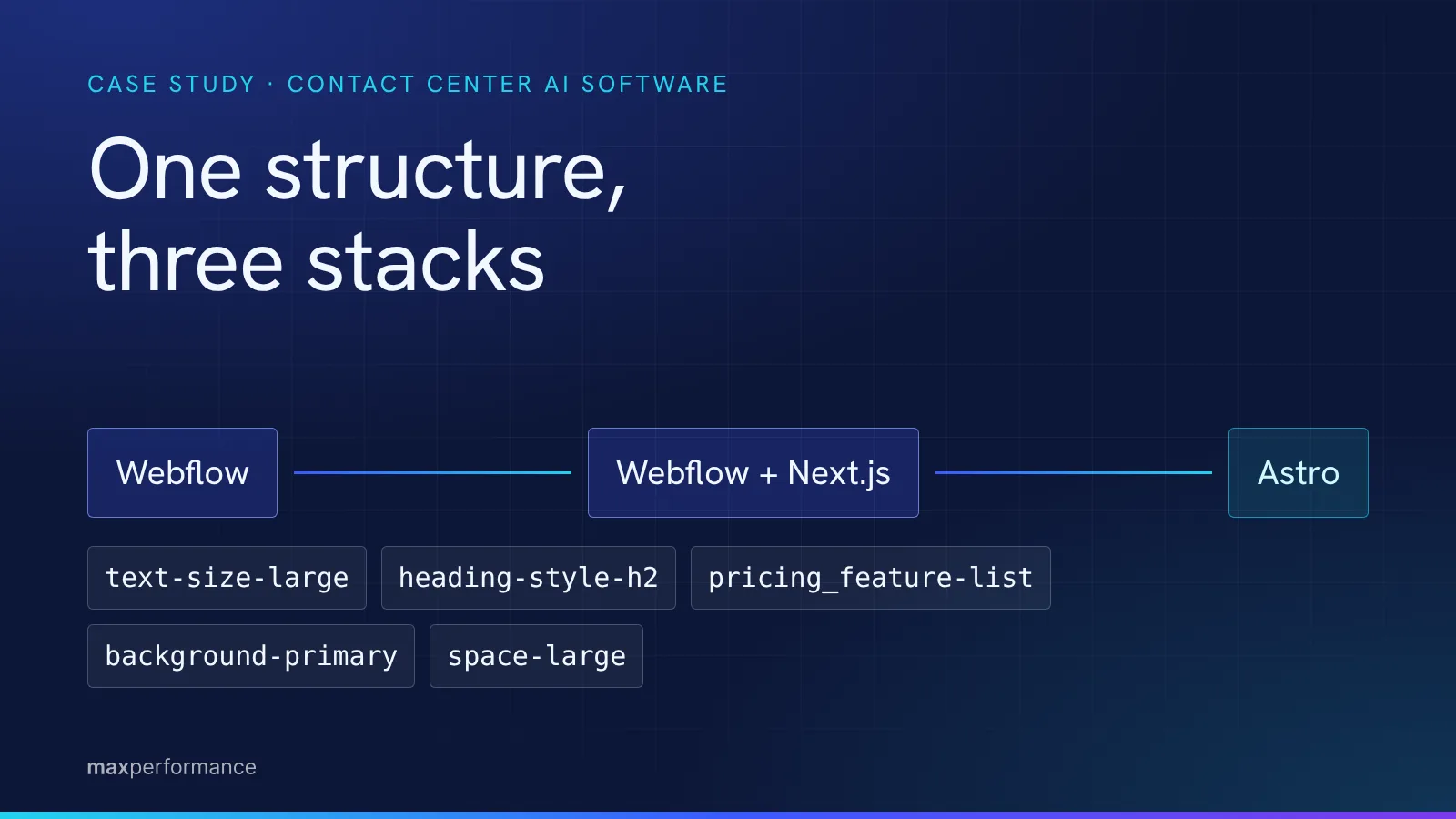
- stacks the structure passed through: Webflow, Webflow alongside Next.js, then Astro
The search strategy behind these numbers belongs to the company's own search consultant. What Max Performance built is the structure underneath them, and this page is about that.
TL;DR
Challenge
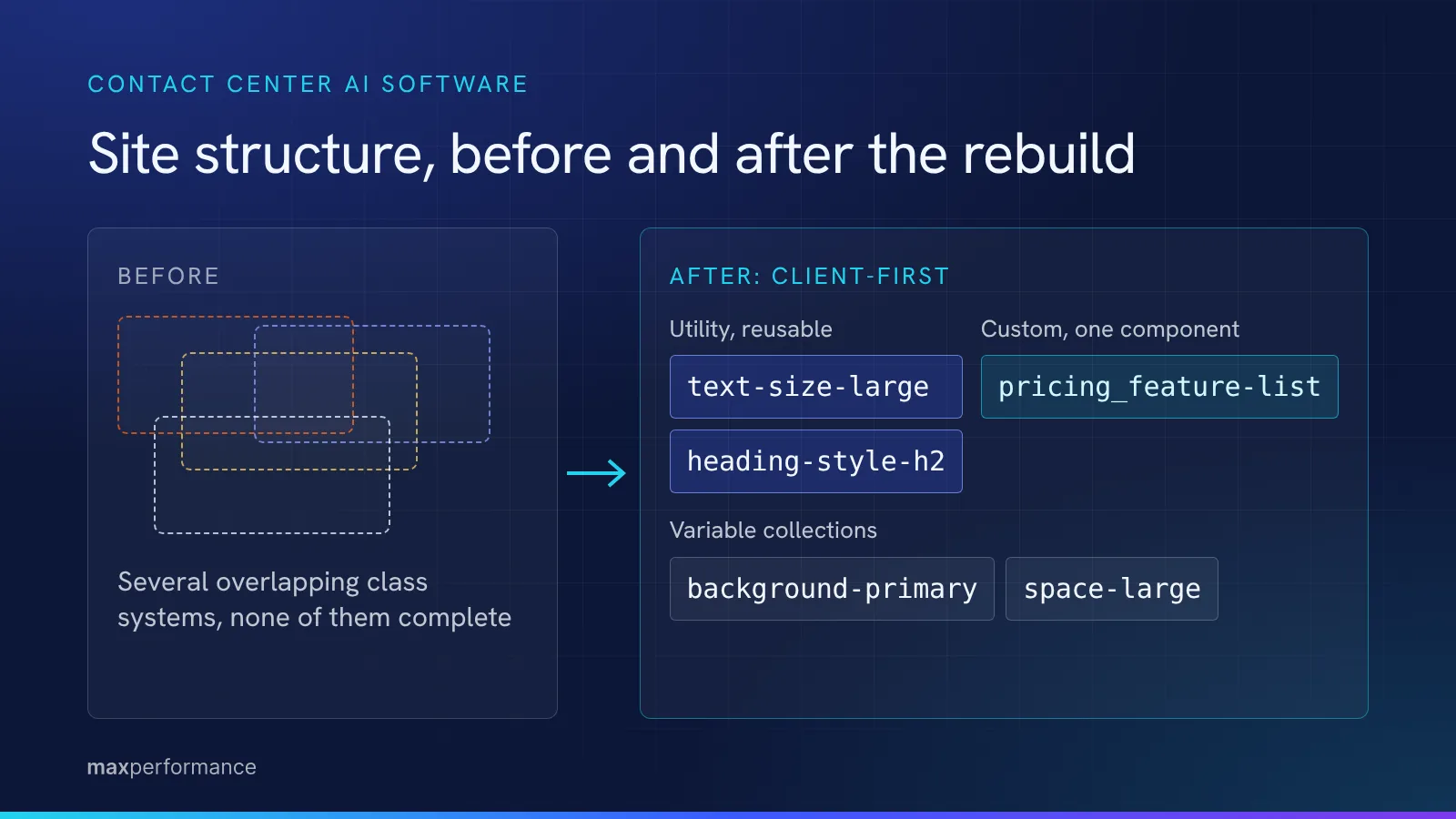
A company selling AI performance enablement to contact center teams, growing fast, with search as its main channel. The front end had been extended repeatedly as the company expanded and had accumulated several overlapping class systems, none of them complete. Every new page was a negotiation, and a search strategy that was already good was capped by what the site could carry.
Solution
Max Performance came in as the outside web team, reporting to the marketing director and coordinating with the company's search consultant. The front end was rebuilt on Client-First, the published Finsweet standard, with a style guide wired to variable collections and heading structure decoupled from heading size. A Webflow DevLink pipeline carried components into the Next.js side of the site. When the site later moved to Astro, Max Performance designed the site and the design system and the company's own team completed the rest from inside.
Outcome
201 keywords in the top three positions, organic traffic worth about $38,000 a month, correct page structure inherited from templates rather than requested page by page, and a marketing team that extends the site without an agency in the loop.
Key facts
- Industry
- Contact center software
- Segment
- AI performance enablement for contact center teams
- Market
- United States, enterprise and global business process outsourcing
- Engagement
- Ongoing, as the outside web team
- Reporting line
- Marketing director, coordinating with the company's search consultant
- Services
- Website design, design system, Webflow development, website maintenance, Astro design system
- Stack
- Webflow with Client-First, Webflow DevLink, Next.js, Astro
A company that grew faster than its front end could follow
The company sells AI performance enablement to contact center teams, and most of its growth ran through the marketing site, with search as the main channel.
It had grown quickly and the front end had not kept pace. Several class systems overlapped, added at different points as the site expanded, none of them finished. A site in that state does not announce itself: it looks fine, and it fails quietly at the twentieth page. There is no predictable place for a new class, no way to know whether changing one affects something else, and no way to tell which of three similar classes is the live one.
So what was needed was not a redesign. The design was not the problem.
What it was actually costing them
The marketing team knew what it wanted to publish. The search strategy was good and already running. Neither of those was the constraint.
The constraint was that every new page had to be argued into existence. Correct heading order had to be requested rather than inherited, so a search specialist's time went into structural corrections instead of into the next page. Output fell to whatever survived the friction.
This is the part most companies misdiagnose. They look at a site that is underperforming, conclude it needs to look better, and buy a redesign. The redesign resets the appearance and leaves the bottleneck exactly where it was.
What Max Performance changed
1. One naming system in place of several
The front end was rebuilt on Client-First, the Finsweet naming and structure methodology that is the de facto standard for professional Webflow projects. Max Performance is a Webflow Certified Partner and builds every project this way.
The whole thing turns on one distinction. A class is either a utility class, reusable across the project and named with dashes, or a custom class, specific to one component and named with an underscore that groups it into a virtual folder. text-size-large is reusable anywhere. pricing_feature-list belongs to the pricing component and nowhere else.
That single rule is what replaced several overlapping systems with one. The practical result: anyone opening the project a year later finds a class by searching the component name, and knows from the name alone whether changing it touches one section or the entire site. The site stopped being something only its original author could edit safely.
2. A style guide wired to variable collections
Colour, spacing and typography moved into variable collections with semantic names, connected to a style guide, so background-primary and space-large are decided once and referenced everywhere rather than living as a hex value somebody pasted into forty elements.
Spacing runs on rem across the site, with pixels kept only where pixels are the correct unit. Section padding comes from a small set of steps rather than a value chosen per section.
The result is dull to describe and it is why a page added two years later sits on the same rhythm as the first one, without anybody measuring anything.
3. Heading structure separated from heading size
This is the change that moved the search numbers, and the least visible one on screen.
In a disordered project people pick a heading level for how large it looks. An H3 gets used because an H2 is too big, and the page ends up with a heading hierarchy that describes the layout rather than the content. Every page built that way is a page a search specialist has to argue about.
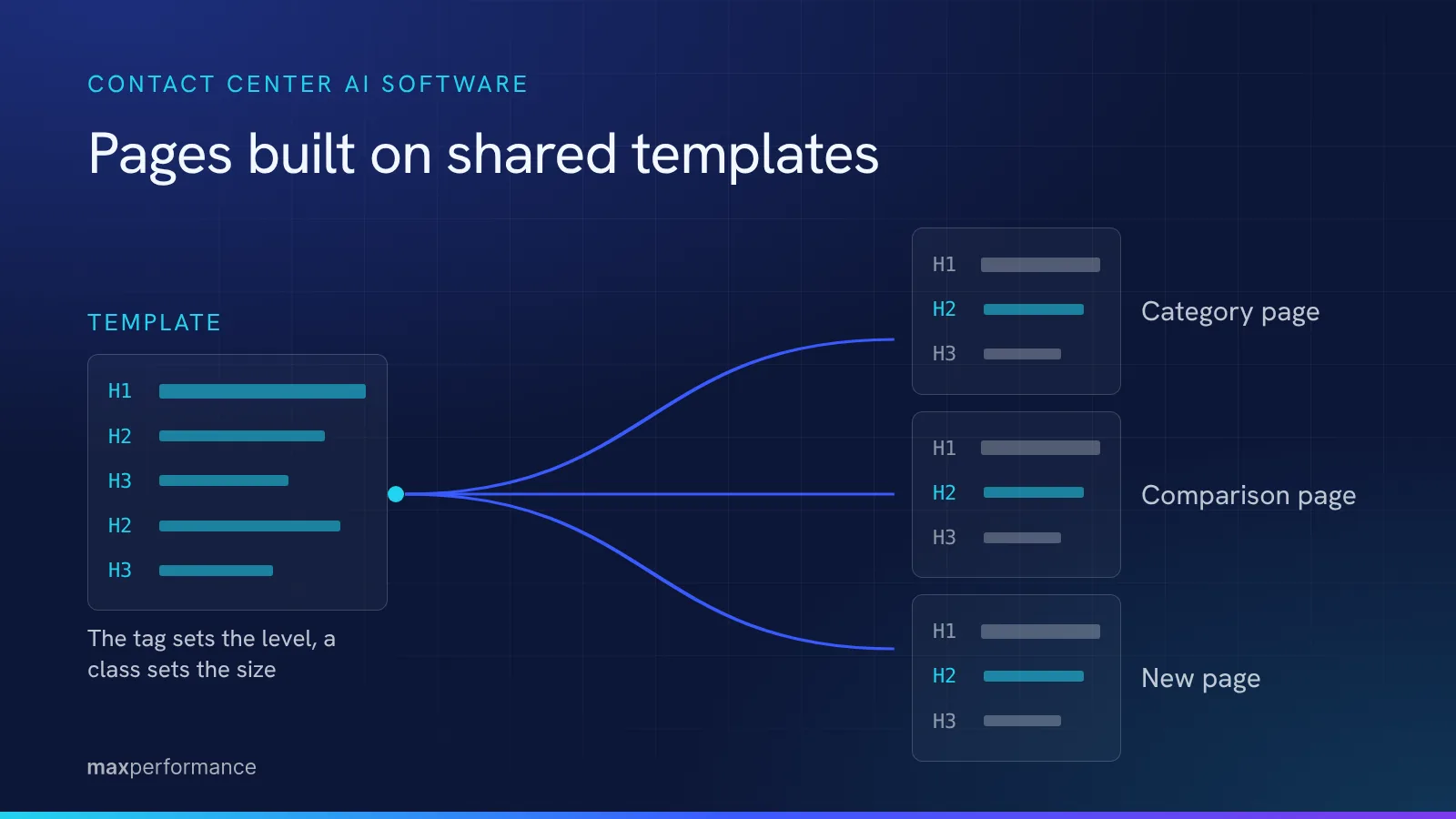
Client-First separates the two. The semantic level comes from the tag; the visual size comes from a utility class such as heading-style-h2. A section carries the correct H2 for its content and still looks however the design needs it to look.
Correct heading structure stopped being a negotiation between design and search and became a property of the templates. New pages inherited it without anyone remembering to apply it, and the search team's hours went back into publishing.
4. Components that crossed from Webflow into Next.js
Part of the site ran on Webflow and part on Next.js. Max Performance set up a Webflow DevLink pipeline so components built in Webflow could be used directly inside the Next.js application, which is how content and components moved between the two without a second copy of each component being maintained by hand.
Most teams are told a migration like that is not realistic. It is not realistic on a disordered site, which is a different statement from it being impossible.
5. A design system the company's own team builds on
In 2026 the site moved onto Astro. Max Performance designed the site and the design system; the company's own team completed the rest from inside, working with its search consultant and its marketing director.
That division is the engagement rather than a footnote to it. The deliverable was never a finished website. It was a structure complete enough that the people using it every day could keep building on it without an agency in the loop.
Astro earned the move on specifics, not on fashion: it ships static HTML with no framework runtime by default, so heading order, schema, internal links and the passages a model would quote are all under direct control and all present without JavaScript. That is the difference between optimizing for a crawler and optimizing for something that has to parse and cite the page.
The structure came across intact, which is the test a system either passes or fails. Most fail it.
Outcomes
$38,000 a month in organic traffic value
Ahrefs values the site's organic traffic at roughly $38,000 per month against what the same visits would cost to buy (October 2026). For a mid-market software company that is the difference between a marketing site that is a brochure and one that is a channel.
201 keywords in the top three positions
449 organic keywords in the United States, 201 of them in the top three. The traffic concentrates in category and comparison pages rather than brand pages, which is the shape you want when search is the main channel.
5,553 monthly organic visits
Ahrefs estimate, United States, October 2026.
Correct page structure by default rather than by review
Pages inherited their heading architecture from the templates, so structural corrections stopped consuming the search team's time.
Three stacks, one surviving structure
Webflow, Webflow alongside Next.js, then Astro. The system came through all three.
A team still building after the agency stepped back
The clearest outcome of the engagement, and the one with no number attached to it.
Why it worked: nobody was doing it alone
Max Performance rebuilt the front end, built the page system and designed the design system. The search strategy belongs to the company's search consultant; the content and the day to day running of the site belong to its marketing team.
Saying which is which is the point of the case rather than modesty. The search work was already good before Max Performance arrived and on its own it was not producing this. Part of the company's online growth, and of the demo requests that came with it, sits exactly where the three overlap: the strategy, the team running it, and the structure underneath.
The uncomfortable version of the lesson: a marketing site rarely limits a company by being ugly. It limits them by how many decisions it takes to add a page correctly.
What this means for other contact center software companies
If you are paying for search work while nobody can fully explain how your site is built, you are paying for output you cannot ship. A redesign resets the appearance and leaves that untouched.
Three things worth taking from this:
- Buy the structure, not the redesign. Ask any agency which published naming standard they build to, and what happens when you need page twenty-three. If the standard is their own invention, the answer is unverifiable and you are buying a dependency.
- Insist that heading level and heading size are independent. If they are not, your heading structure will describe your layout instead of your content on every page, permanently, and your search budget will be spent on corrections.
- Judge the handover, not the launch. The question is whether your own team can extend the site a year later. If the answer depends on the agency still being there, you bought a website rather than a system.
There is more in how this was done than belongs on a page. Max Performance walks through it on a call, against your own site.
 Book a Gap Audit